Showing posts with label Wargames Miniatures. Show all posts

Thursday, July 11, 2013

Testing Techniques for Painting Horses


Oh horses, why do you vex me so? I've found cavalry to be an essential branch of the ancient and medieval armies I'm painting up. They typically have dynamic movement capabilities and impressive combat stats in game, and a large mass of cavalry figures looks impressive. But I still can't find any enthusiasm for painting up that much horse flesh.

In an effort to determine the quickest way of painting up mounted troops, I tried out three different techniques on some Conquest Miniatures Norman cavalry. Painting to wargame standard, I wanted to compare the final product with regards to the time and effort required to complete the paint job. My horses after the jump.

The horse blankets and straps haven't been finished, and some of the subtleties of the shading are lost in these photos (I'm really looking forward to getting into the new house with it's proper studio lighting), but hopefully there's enough detail to discern differences between the three techniques.

3 Color Steps 


This is a standard painting technique that's become associated with it's most proficient practitioner, Kevin Dallimore. I started with a dark base color, and then worked up two shades of highlights on the raised surfaces. I'm still finding my way around horse musculature in order to pick out the muscle definitions, but I was fairly pleased with the results. I followed the colors suggested in the Wargames Soldiers and Strategy article in issue #66. Trying to create my own three step shades was difficult. If the jump in color from one highlight to the next is too great the result looks stark and unnatural.

Effort: Challenging
Time: Several painting sessions
Result: Good

Oil Wipe 


This is an easy technique I read about online, but requires quite a bit of patience. The horse is given a relatively light base coat with your standard water based acrylics (Vallejo, GW, etc.). Once dry, the figure is slathered with a darker oil based color, which is then wiped off with a towel. To get to tricky parts (the inner leg for example), I used a q-tip to navigate into hard to reach areas. The darker oil paint is removed from the raised surfaces, and the wiping process tends to create a subtle gradation from highlight to darker recesses where the towel or q-tip can't reach. The oil paint takes a long time to dry though. I believe these horses took a week before they were no longer leaving a residue when touched. I really like the effect on dark horses, but I haven't risked doing lighter dun, gray or white coats yet.

Effort: Easy
Time: 1 painting session, 1 week drying
Result: Fair

Army Painter Dip 


For the dun horses I tried the dip method using Army Painter Soft Tone . I gave the horses a base coat of yellow / tan, and brushed on the Army Painter dip. When using Army Painter on humans, I'll often go back and pick out a few highlights, but for these horses I wanted to see how they turned out with just the dip technique. The dip works best with plenty of deep crevices and fine detail, and I think it got a little muddy and pooled on the larger surfaces areas of the figures flanks. Still, it gives some shading and requires very little effort.

Effort: Easy
Time: 1 painting session, 1 day drying
Result: Acceptable


Results


A shot of the large flank areas, of the (L to R) oil wipe, three step, and dip methods.  


I'm glad I undertook this exercise. For show pieces or commanders, I think the 3 step process gives the most amount of control, and can be further expanded into four, five or more steps to capture some truly dynamic or subtle shading.

For the rank and file though, I didn't find the three step process produced a notable improvement over the other two techniques. The Army Painter dip is quick, but I think it needs a layer of highlights to avoid a dingy final product.

The oil wiping technique takes quite a long time to cure, but the ease of applying it and the results make it the clear choice for pumping out tons of cavalry.

Hope you found this helpful. With the horses done, I'm on to the riders next. I might even get them done before Historicon. :)


Sunday, April 28, 2013

Kickstarter Roundup: Dungeons and Hussars


There a pair of Kickstarters I'm following, one just wrapping up and one just getting started: Dwarven Forge's "Game Tiles" and Wargamer's "By Fire and Sword".  More details after the jump.

Dwarven Forge

I've drooled over Dwarven Forge's resin dungeon terrain for years, but the incredible cost has always kept them out of reach. When Dwarven Forge announced their Kickstarter with much more affordable sets, I jumped in without hesitation. I have a huge number of Reaper Bones fantasy figures on the way, I've had a good time with Song of Blades and Heroes, and I've ping ponged between historical and fantasy gaming for the last 10 years. I know I'll get a chance to put these to use.

The Kickstarter is down to the final hours, but check out the free stretch goal addons they are throwing in when you order two sets or more:


I'm splitting multiple sets with friends plus adding some additional packs for enough tiles to cover a good sized gaming table. Something like this:


There also a number of excellent painting videos showing how easy it is to drybrush these tiles yourself. The Dwarven Forge "Game Tiles" Kickstarter ends April 30.

By Fire and Sword

I know nothing about 16th century Polish warfare, but I'm being tempted solely by the gorgeous rule book produced by Wargamer for their "By Fire and Sword" rules.


It appears to be quite a tome, and there are already fully armies for the factions included in the rules. Unlike most Kickstarters the product is already ready to be shipped, and Wargamer is using the funds to ramp up the English translation of the rules that have been in Polish for a number of years.

The English rules were released at Salute (I'm hoping to find a review of them soon), and it appears they are geared for both small skirmishes and large set piece battles.


The figures are in 15mm, which is a bit off putting (I have some 15mm Eastern Front WWII terrain that might be able to pull double duty, but 15mm isn't a scale I am heavily invested in), and I already have enough projects I'm juggling, and I 16th century Eastern European warfare is going to be a tough sell for my game group, but I'm thinking of getting the rules just to read and compare to other sets. I stil have time to decide as the "Fire and Sword" Kickstarter ends May 20.


Saturday, April 27, 2013

Converting and Painting Reaper Bones


Although mine haven't arrived yet, the Reaper Bones Kickstarter shipments are wending their way across the world into eager hands, some of which have never picked up a paintbrush before. I had another Bones figure on hand to do some converting tests upon, and figured it might be helpful to go through my painting process to offer advice to folks who now have several hundred figures to paint up. Don't worry  new painters! It's not all that hard, it just takes some patience and practice. My tips after the jump.

Tools: Hobby Paints


Getting started on your Bones minis might seem a bit daunting. Paints? Brushes? What to pick? For paint, I prefer Vallejo paints. They come in small dropper bottles, so you can dispense just a single drop of paint if necessary, and they are remarkably smooth and "thin". There are a number of basic sets to get you up and running (for example Vallejo Orcs and Goblins Paint Set, Vallejo High Elves Paint Set, Vallejo Medieval Colors Paint Set ) or you can purchase them individually. I've found that I have more shades of brown than any other color (ranging from deep chocolate browns to khaki and ivory, with a diversions into greenish gray or warm orange red browns) because they are useful for all manner of belts, shoes, scabbards, hair, furs, skin tones, etc.

Games Workshop paints are also popular, but I found the flip top lids lead to the paints drying out after a year or two in some cases. Still, they seem to be lingua franca amongst figure painters, so it's easy to match colors when someone mentions a shade they used.

There are a number of other brands of modeling paints (Reaper, Army Painter, Coat D' Arms, just to mention a few) all of which are fine products. You should get them.

Tools: Craft Paints


Modeling paints can get pricey though, so if you are just starting out don't feel bad about picking up some craft paints. A number of figure painters use craft paints exclusively, and produce very good results with them. They are cheaper, more readily available, and come in just as many shades as hobby paints. Color matching is a bit trickier, and I've found they are thicker and require a bit of water to thin them out before applying. I freely mix both types of paints depending on the effect I'm trying to achieve.

Tool: Paintbrushes

I go through paint brushes frequently. I've tried to go cheap on brushes, and I don't think it's worth it. Steer well clear of "watercolor" brushes (the bristles are too limp to control easily), avoid synthetic brushes if possible. I try to find some natural sable hair brushes. I picked up some Army Painter brushes and have been very pleased with them.

Tools: Spray Paints

Reaper Bones don't require any spray primer, but if you branch out into figures of any other material (metal, plastic, etc.) you'll need a can of spray primer to give some tooth to the figure for the hobby paints to grip. Regardless you'll want a can of matte spray to apply after finishing a figure. The matte spray cuts down on the shine from certain paints and washes, and applies a protective coat to help prevent chipping or flaking to figures that will be handled by greasy pizza fingers on the table.

I use Army Painter Leather Brown Spray Primer for most of my priming, although I'll use a black primer or white for certain effects.  I typically use Testor's Dull Cote for my final overspray of finished models since I can pick it up at local craft and hobby shops.

Converting Reaper Bones


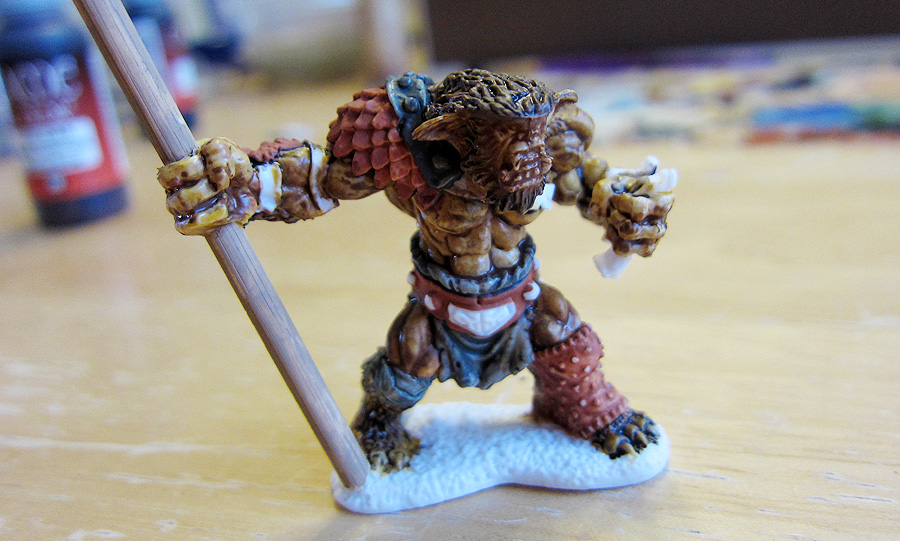
I was happy with my initial tests of painting a Bones figure. For my next test I wanted to see if they could be converted. For this bugbear I wanted to swap out its mornigstar for a spear, remove the spikes from its shield (which were a little over the top for me) and repose the shield arm so it was providing protection to the creature.


First I chopped off the morningstar and shield spike with a hobby kniffe. I also removed the shield to reposition later too. The Bones material is supposed to respond to heat, so I held the figure in boiling water for 45 seconds, bent the shield arm closer to the figure's chest and then held it in ice water for 45 seconds.


I drilled out the bugbear's weapon hand and used a wooden kebab skewer for the spear.


Painting Reaper Bones Bugbear


I usually start by "blocking in" the figure by giving each surface a solid color. I hadn't quite worked out the color scheme for the bugbear, so went about it bit differently this time. I started off blocking in the exposed skin and fur.


Skin blocked in with Vallejo Game Color Plague Brown. The Vallejo paint was a bit thin, but I was pleased with how it took to the Bones material. It almost acted like a wash, seeping into the cracks and crevices of the sculpt, and leaving a tint to the raised areas, naturally shading the figure. I picked up the technique of painting "inside out" from other mini painters. Start with the flesh, then work out (clothing next, followed by boots, belts, straps and packs that are on top of the clothing)


Adding Vallejo Game Color Beasty Brown to the darker fur areas on its head and back. To smooth the transition from the brown fur to lighter skin, I dipped my brush in water, the dipped it in a drop of the paint and applied it to the border between the fur and skin. The thin paint tinted the lighter yellow skin and created a smoother transition between the two.


Mostly blocked in. I chose a warm yellow and brown for the bugbear, and used Vallejo Red Leather and a dark green (a mix of Vallejo Black and light green craft paint) for the various leather armors and cloth items. I wanted the creature's fur and skin to be quite a bit darker than what you see here. The more colorful reds and greens should add some visual interest to the creature, but you can see I've left some of the straps unpainted at this point. I wasn't sure how dark the eventual skin and fur were going to turn out, and I wanted to be sure the straps placed over its skin would contrast.


Next up I added a dark wash. I usually use Games Workshop washes, but I didn't have any in the deep brown shade I was looking for, so I created my own. I put down two drops of Vallejo Game Color Charred Brown on my palette and loaded my paint brush with water. Mixing the two gave a very thin deep brown paint. Brushing it over the brown fur, it worked its way into the deep crevices and tinted the highlights.


I washed all of the exposed skin and fur of the bugbear. Notice how it picked out the details of the creature's face, defined the fingers and toes, etc.


Now that the fur and skin were closer to their final color I picked a light gray for the straps to contrast with the deeper skin color, and finished blocking in the rest of the colors. With a similar wash to the other straps, belts, cloth, and armor, this figure could be considered table ready. I went on to add a few highlights and pick out some details though to finish it off.


The scaled shoulder armor was blocked in with red leather (made from dragon scales maybe?). To highlight them I mix a drop of the Red Leather and a drop of light yellow craft paint. I painted the bottom half of each scale with this lighter shade. Next, I added another drop or two of light yellow to the mix and painted just the edge of each scale. It's a bit fiddly. I used my small detail brush, and hold my breath while I paint the scales. The goal is to get a suggestion of color on each scale, so that at a foot or two of distance the scales "pop".


For metal studs, I painted each black and placed a dot of Vallejo Oily Silver on each one. Teeth were picked out in Vallejo Bone White, tongue in Red Leather, and raised surfaces of the skin (knuckles, the edges of his pecs, thigh muscles, etc.) were given a dab of Vallejo Plague Brown. I wasn't happy with the original shield, so I used the boiling water method to flatten it, then reglued it with super glue into a more traditional position.

I left the base unfinished as I'm planning on creating a unit of these creatures for some mass fantasy battles in the future and will base them all together, but that's a post for another day.


One of the big revelations to me in painting this bugbear up is how well it takes thin paints. The white color of the Bones material allows you to gradually build up colors by applying multiple layers of thinner color. Also, the details on Bones are good, but comparing them to metal versions I think they are a little shallower. I'd be very careful in applying thick paint as it is likely to settle into crevices and obscure detail more easily. Good luck with your own painting! Patience and practice is all it takes :)

Saturday, April 20, 2013

Lousy Roman Cavalry

Checking my lead pile I found a baggie of loose Roman cavalry I picked up off of eBay or TMP a few years ago.  My Romans are starting to get outnumbered by Carthaginians and Gauls so I figured it was high time to give the legions s a few reinforcements.

I spent last evening prepping and cleaning them, looking forward to getting to the actual painting over the coming week. I tackled the horses first and was surprised at the amount of flash they had, and some of the poor sculpting on them.

Horses


First take a look at these horses. I know horses are difficult to sculpt, but these are really quite terrible.
These look more like mules to me rather than powerful steeds.

And look how narrow! 
The horse bases were also warped and took a lot of bending just to make them stand up at all. The riders were just as bad. Check them out after the jump.


Riders

The proportions on these figures are way off, the poses are strange, and they are full of flash and miscastings.
What is this guy doing with his left arm? His hand is cupped near his face... a hand that should be holding a shield.

This guy could scratch his ankle without beding over.

I'm sure the enormous paddle hand is distracting, but be sure not to miss the amputated right foot.
I found several figures identically miscast. 
Frustrated with the poor quality of these figures I gave up trying to fix and clean them but I'm not quite sure what to do with them. Perhaps I can turn them into casualty figures, but they really deserve to be melted down and recast as something better.

One peculiar thing about these figures: the hands holding weapons would need to be drilled out to accept spears. Does anyone know who produced these figures? I'd like to steer clear of the manufacturer in the future.

Sunday, April 14, 2013

Crusader Miniatures 28mm Republican Roman General

I finished up a Republican Roman general and thought I'd share. I thought the horse sculpt was better than average, I really like the officer on foot, but the general himself has some pretty wonky eyes. Still, I'm pretty happy with the actual figures. The painting could be better, as I really struggle with horses. I've got quite a herd of cavalry in my lead pile though, so I'm sure I'll get some practice soon enough.


Tuesday, April 2, 2013

Warlord Games Celt Leaders

Getting back into the swing of things, I polished off a few barbarian leaders that had been stuck in my lead pile for far too long. The Celtic Chieftains from Warlord Games comes with three fearsome warriors. I used one for a more "germanic" command stand that I painted up last year, but chose to keep these remaining two as definitely Gallic.


The horned chieftain was quick to paint up. His broad cloak took a plaid pattern easily.

I wanted to include a second figure for the bald leader, but needed to create a height difference between the chieftain and his companion for their positioning to look correct.

I used some wood chips to represent bare, exposed stone, and filled in the gaps with bits and pieces of pink insulation foam.

A thick coating of white glue and flock filled in any other gaps, and the addition of a naked buddy and baldy is ready to go.